Twelfth of August
What will happen on 12 August 2026?
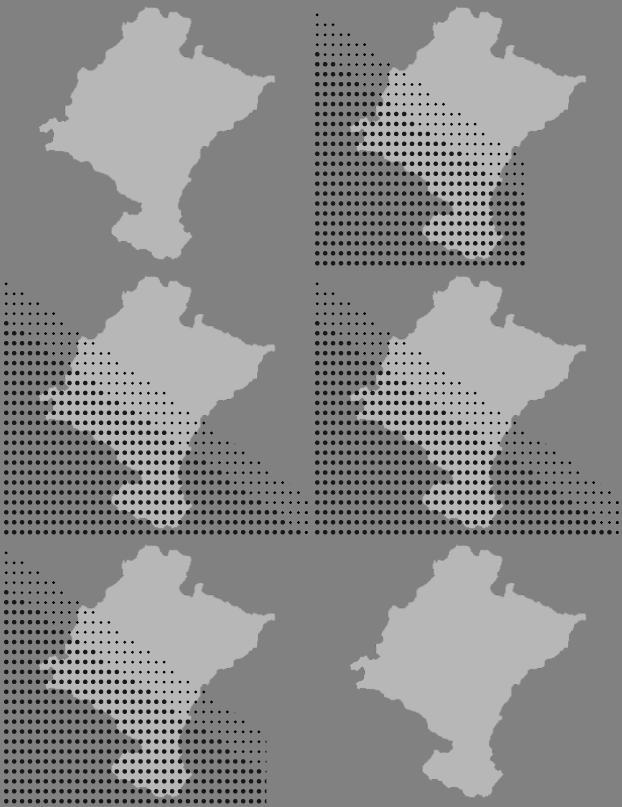
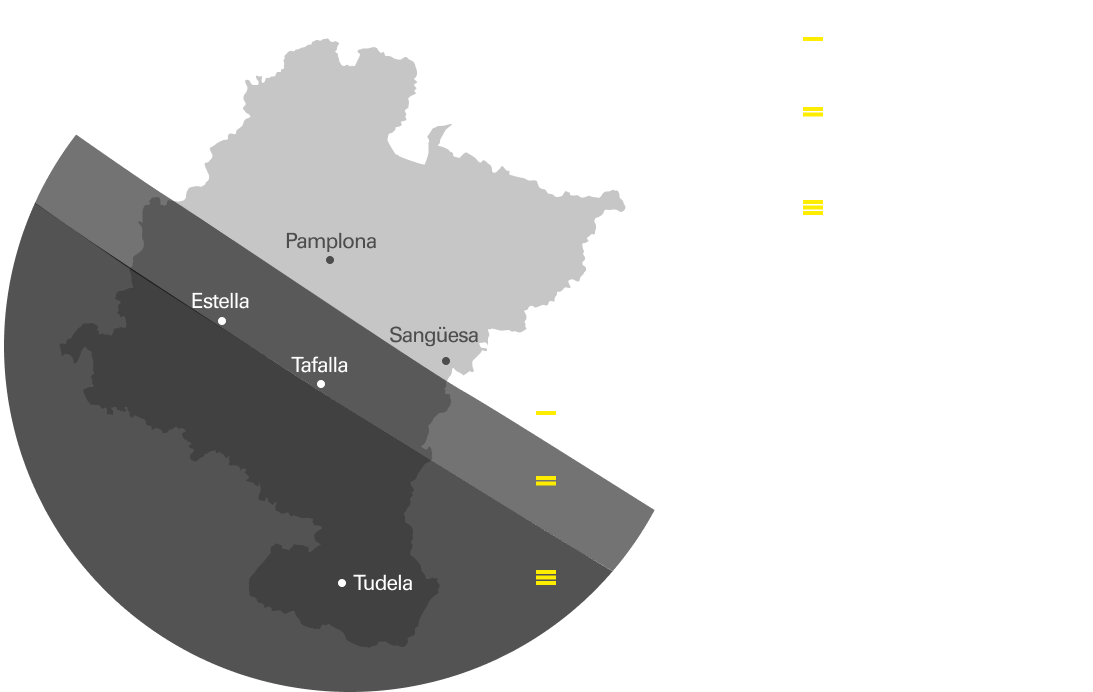
On 12 August 2026, the eclipse will begin across all of Navarre almost simultaneously, at around 19:32 official time. The Sun will already be very low (about 7°) towards the west-northwest, so from the very beginning it will be a “sunset eclipse”.
From that moment on, the Moon will gradually cover the Sun until reaching the key moment, which in Navarre occurs within a very narrow time frame between 20:28 and 20:29.
Midlands and Central-West
For example, Abárzuza, Abáigar, Estella, Tafalla, …
The eclipse will become total, but for short durations, on the order of 40 to 60 seconds.
Ribera
The farther south one goes, the longer totality becomes. In the Tudela – Castejón – Cintruénigo – Corella – Cascante – Ablitas – Tulebras – Fitero strip, durations clearly exceed one minute and reach 1 minute 20 seconds (Tudela is at 80 s), and up to 1 minute 27 seconds at the southern end (Monteagudo 87 s, Tulebras and Fitero 86 s, Ablitas and Cascante 85 s, Cintruénigo 84 s). In other words: in the Ribera, totality lasts well over one minute.
Northern area
Pamplona – Basin and northern valleys. The eclipse will be very deep, but only partial: the Sun will appear heavily “bitten” around 20:28, but the corona will not be visible and it will not really become night.
After the maximum, throughout Navarre the Sun will remain partially covered until it sets, between 21:11 and 21:14 depending on the municipality. What people will actually witness is an eclipsed sunset.
Time of the eclipse
On the day of the eclipse, the Sun will set in Navarre between 21:11 and 21:14, depending on the municipality. What the public will observe at that moment, once the total eclipse has already passed, will be a partially eclipsed sunset.

Why will it only be visible in one strip?
When the Moon passes in front of the Sun, its shadow does not cover the Earth’s surface equally. There are two shadow zones that matter in a total eclipse:
01. Umbra
This is the central part of the shadow, the darkest. Here the Moon covers the ENTIRE solar disc. If you are inside the umbra, you see a total eclipse.
The umbral zone is narrow; that is why on maps it appears as a band crossing the territory.
02. Penumbra
This is the area surrounding the umbra. Here the Moon covers only part of the Sun. If you are in the penumbra, you see a partial eclipse, even if it is very deep (the Sun may look heavily “bitten”), but unless you enter the umbra, it is not total.
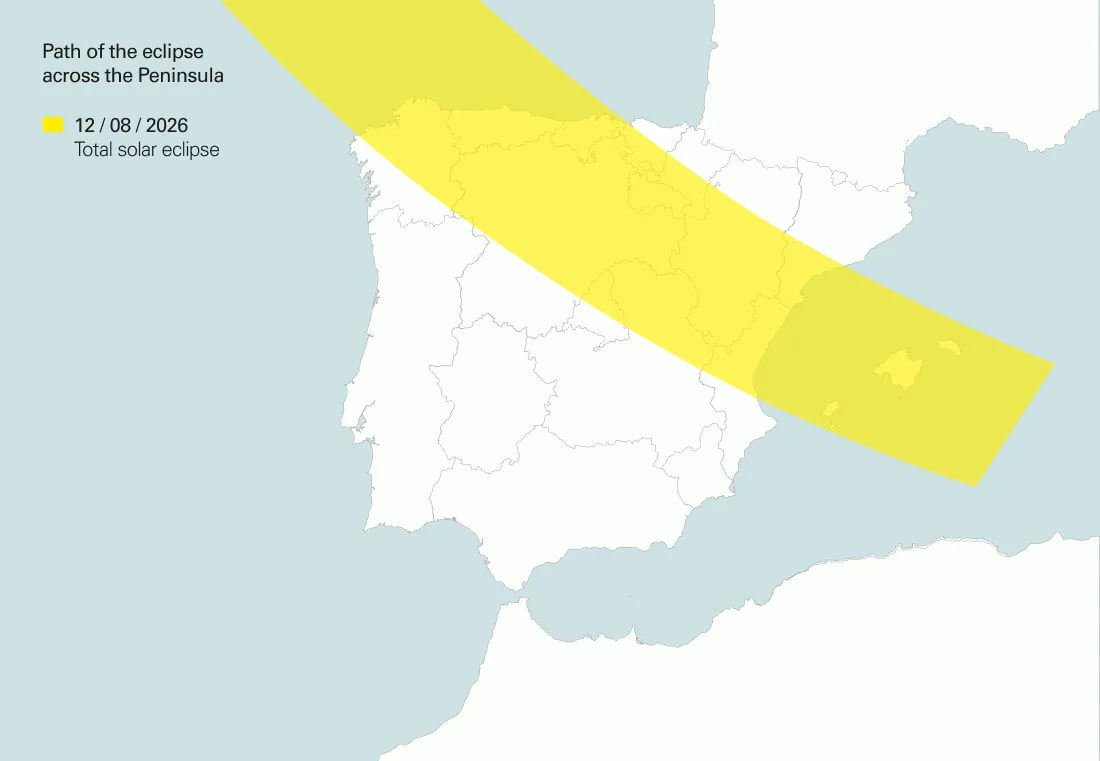
In the eclipse of 12 August 2026, what happens is that the Moon’s umbra crosses the Peninsula along a very specific route. This route is what we call the path of totality.
Anyone within that path will see the Sun disappear completely for a few seconds or for well over a minute (in Navarre, especially in the Midlands and Ribera, according to the data provided). Anyone outside it, even just a few kilometres away, will already be in the penumbra and will see only a partial eclipse.
“Path of totality”
In the eclipse of 12 August, the Moon’s umbra will cross the Peninsula following a very specific route. This route is known as the “path of totality”. Anyone within the path of totality at the time of the eclipse will be able to see the Sun disappear completely.

The shadow across Navarre
The total shadow enters Navarre from the west, in the Tierra Estella area (around Abárzuza, Abáigar, Aberin) just before 20:28.
In less than a minute it crosses the Midlands following an approximate west–southeast direction (Tafalla – Olite axis) and reaches the Ribera (Castejón, Tudela, Corella, Cascante, Monteagudo) around 20:29, where totality lasts longer, up to 1’20” – 1’27” depending on the municipality.
Areas farther north (Pamplona and the Pyrenean valleys) lie outside that corridor and will only see a very deep partial eclipse.
The eclipse in the 272 municipalities
In this search tool, you can type the name of a municipality in Navarre and check its eclipse observation data: eclipse start time, start of totality, maximum point, end of totality, eclipse end, and duration of totality.
* The total eclipse will only be visible in municipalities with data on the Start and End of Totality.
Check when and where the eclipse will be seen from any point in Navarre geography
The IDENA viewer allows you to explore a map so that anybody can know, at the exact place where they are, what time the eclipse of 12th August will begin, when the maximum moment will be, when it will end, if it has any physical obstacle (mountains, buildings or trees), and if at that point it will be totally or only partially seen. A project developed by the Directorate General of Telecommunication and Digitisation in collaboration with the public company Tracasa Instrumental.