Eklipse Project

What is the Eklipse Project?
The Government of Navarre, through the Department of University, Innovation and Digital Transformation, together with NICDO and Pamplona Planetarium, has designed the Eklipse Project. This project, which includes the scheduling of a wide range of activities throughout 2026, has three main goals: to position Navarre as one of the regions from which this astronomical phenomenon can be experienced in its entirety; to bring scientific knowledge closer to the public; and to ensure that this event can be enjoyed under the best possible health and mobility safety conditions.
Last Total Solar Eclipse
121 years have passed since the last total solar eclipse visible in Navarre. Partial solar eclipses can recur in the same location every few years, but this is not the case with total eclipses. No total solar eclipse has been observed in Navarre since 1905.

Spain’s trio of eclipses
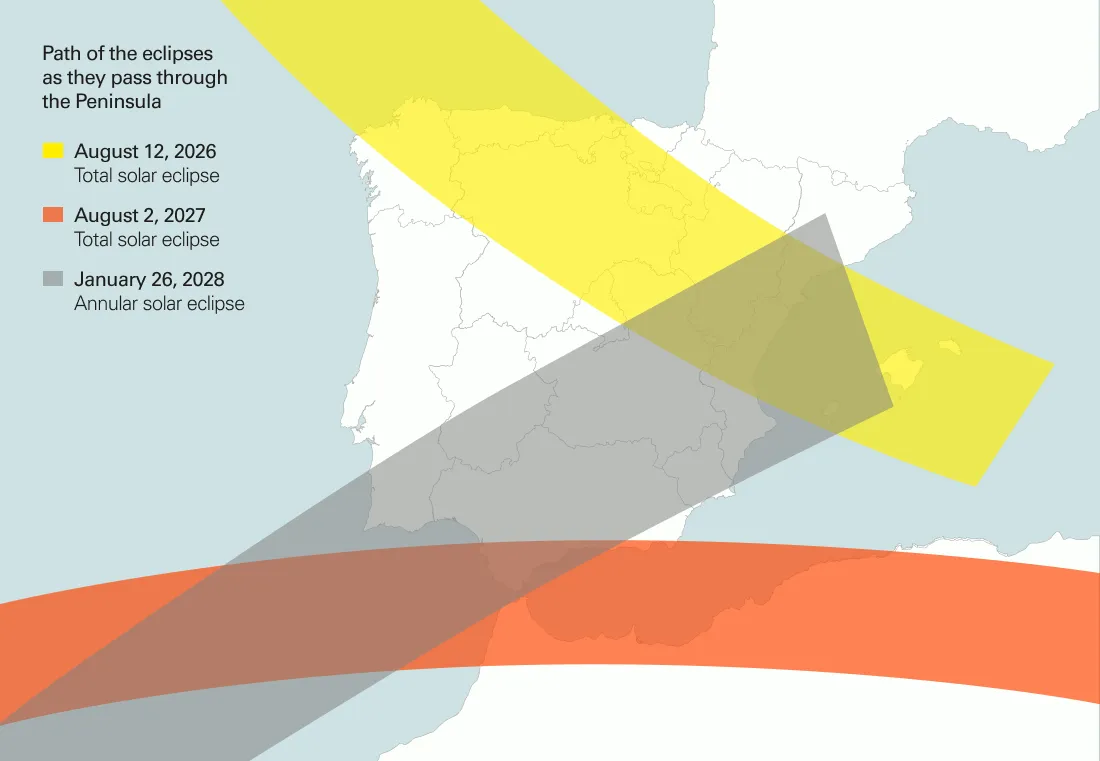
The Iberian Peninsula will witness a historic astronomical milestone with three consecutive solar eclipses. The cycle will begin on August 12, 2026, with a total eclipse that will cross the southern half of Navarre. In the following years, the alignment of the Sun, Moon, and Earth will continue with a total eclipse on August 2, 2027, and an annular eclipse on January 26, 2028. Although the regions of maximum intensity will shift southward, from the territory of Navarre both events will be observable as large partial eclipses, completing a trio of unique phenomena in our century.
An exceptional phenomenon
Navarre will experience a historic milestone with the trio of eclipses: the 2026 one will be seen as total, while those of 2027 and 2028 will be observed as large partial eclipses.
#1
Total solar eclipse –
12 August
On 12 August 2026, Spain will experience its first total solar eclipse in more than a century. The path of totality will cross the north and centre of the peninsula, allowing day to turn into night for a few minutes before sunset. As it will occur in summer and late in the afternoon, it will offer a unique visual spectacle, with the Sun low on the horizon.
The first eclipse of the trio
The total solar eclipse on 12 August 2026 will be the first visible in the Iberian Peninsula in more than a century, and in many areas totality will last almost two minutes, with the Sun very low on the horizon while it is completely eclipsed.
#2
Total solar eclipse –
2 August
On 2 August 2027 there will be another total solar eclipse visible from Spain. On this occasion, the path of totality will mainly cross the southern part of the peninsula before heading towards North Africa. In the areas lying within that path, the Sun will be completely obscured in the middle of summer and with the Sun higher in the sky than in 2026, so the darkness will be more noticeable. In the rest of the peninsula it will be seen as a partial eclipse.
The longest eclipse of the century
The total solar eclipse on 2 August 2027 will be one of the longest of the 21st century. At its maximum point it will last 6 minutes and 23 seconds, because the Moon will be close to the Earth.
#3
Annular solar eclipse –
26 January
On 26 January 2028, an annular solar eclipse visible from much of Spain will take place. In an annular eclipse, the Moon passes in front of the Sun but does not cover it completely, leaving a ring of light around it. Although its appearance is different from that of a total eclipse, the safety measures are exactly the same: proper protection must be used from beginning to end in order to observe it.
The solar ring
During this phenomenon, the Moon does not completely cover the solar disc, leaving a characteristic “ring of fire”, and it is essential to use appropriate eye protection at all times.